
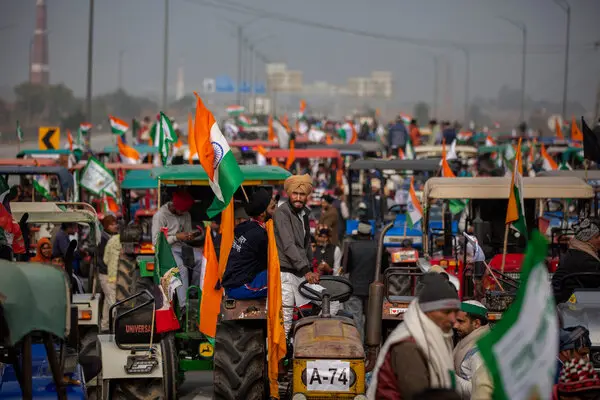
Thousands of Indian farmers have resumed their march to Delhi, demanding minimum price guarantees for their crops. The protest, initially suspended at the end of February after a young farmer’s death, has reignited amid tight security at Delhi’s borders. To prevent the march, heavy barricades have been erected, and police deployment is intensified.
Key Developments:
March Resumes: The farmers, an influential voting bloc, are marching once again to Delhi to press for minimum price guarantees for their crops. This move comes just months before general elections in India.
Security Measures: Delhi’s borders are heavily barricaded to prevent the farmers from reaching the capital. Tight security measures, including increased police presence, have been implemented.
Previous Suspension: The farmers had suspended their protest at the end of February following the death of a young farmer during the demonstrations.
Government Talks: Earlier attempts at talks between the government and farmers’ unions broke down multiple times as authorities could not meet all the demands. The farmers are seeking assured pricing, pensions for the elderly, debt waivers, an increase in work days under rural employment schemes, withdrawal from the World Trade Organization (WTO), and the scrapping of free trade agreements.
Public Transport and “Rail Roko”: Farmers plan to converge in Delhi using public transport, including metros and buses. They have also called for “rail roko,” where trains will be stopped for four hours on March 10.
Background: The farmers’ protests are linked to the 2020 demonstrations against proposed farm laws. While the government withdrew the proposed rules in November 2021, farmers now claim that the government has not fulfilled additional promises made in 2021.
Previous Violence: The protests turned violent in February, with police firing tear gas, and a 22-year-old farmer died at the Punjab border. The family refused to cremate his body, demanding action against police personnel allegedly involved in the incident.
Current Political Context:
The resumption of the farmers’ protest holds significance as India approaches general elections. Farmers play a crucial role in the country’s politics, and the federal government, led by Prime Minister Narendra Modi, is keen to avoid antagonizing this influential voting bloc during the election season.
The ongoing protests reflect the persistent demands of farmers for agricultural reforms and highlight the complexities surrounding the relationship between the government and the agriculture sector in India.


